Why teamwork is harder for humanoids than it looks
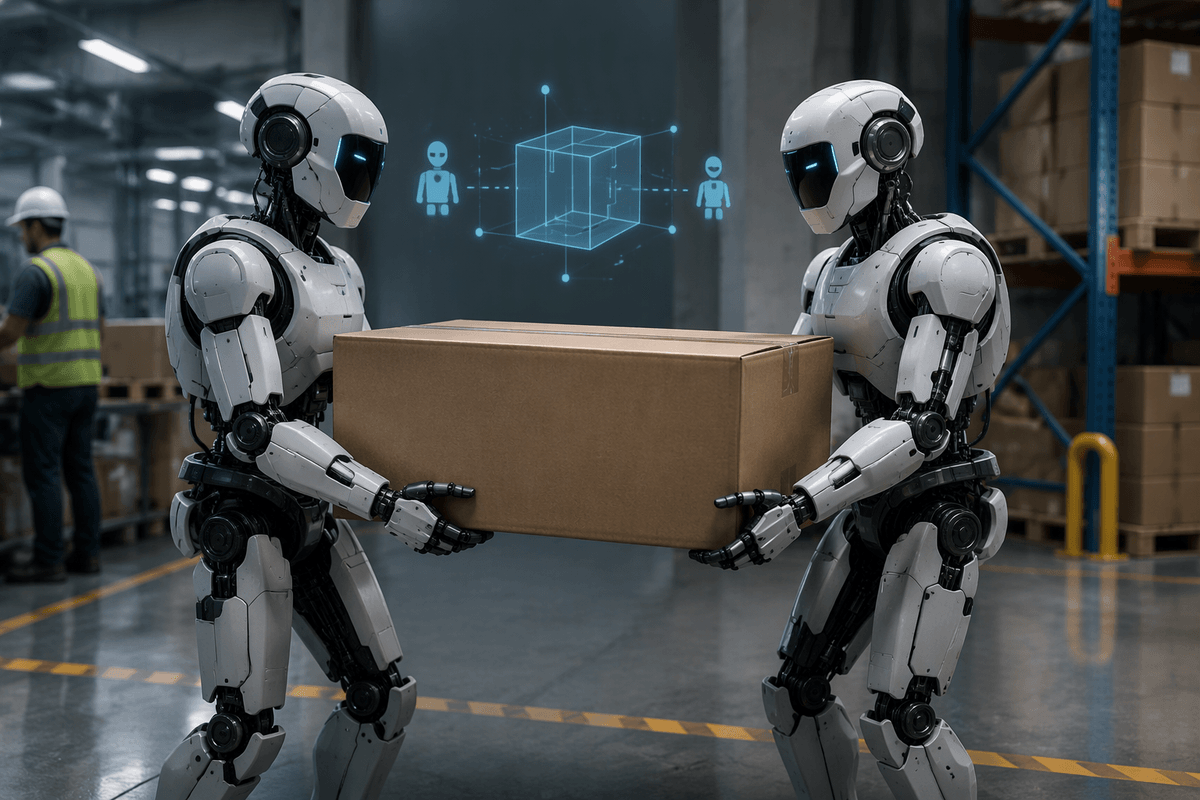
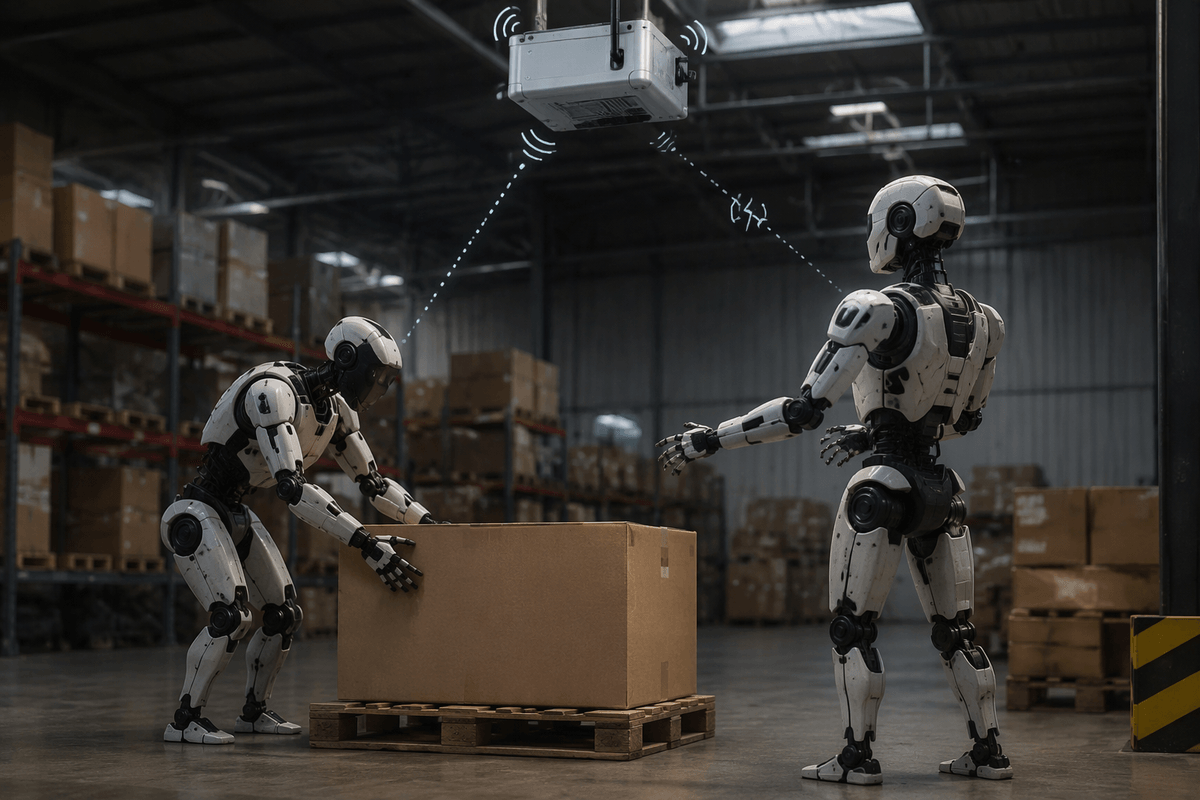
Watching two humanoid robots carry a box together looks like a simple “do the same thing at the same time” problem. In practice, each robot has its own cameras, timing jitter, small calibration errors, and slightly different contact with the floor and the object. If one robot thinks the box edge is 2 cm left, or reacts 100 ms later, the pair can twist the load, slip, or push each other off balance. The hard part is not just motion—it’s maintaining a shared, constantly updated picture of the workspace while deciding who leads, who yields, and how to recover when the picture is wrong.
Shared goals, separate bodies: defining the task and roles
A familiar failure mode is two robots “helping” the same way: both reach for the same handle, both try to stabilize the same corner, and neither knows who should adjust when the object tilts. Real systems avoid this by turning a vague goal (“move the box to the shelf”) into a task description that can be decomposed: grasp points, allowable forces, target pose, and constraints like “keep upright” or “don’t block the aisle.” Roles then become explicit commitments, not social metaphors—one robot can be designated the pace-setter for motion, while the other prioritizes compliance and alignment, or one handles perception checks while the other maintains contact.
These role definitions must be specific enough to prevent conflict, but flexible enough to change when a grip slips or a third obstacle appears. Too rigid, and the team freezes when reality deviates. Too loose, and you’re back to two bodies making incompatible choices.
How robots agree on what’s happening in the workspace
Picture two robots looking at the same box from different angles while a worker walks between them. Each robot has a partial, noisy view, so “agreeing” usually means building a shared state estimate: where the box is, who is touching it, and what in the scene is changing fast enough to matter. The common trick is to fuse local sensing (cameras, joint encoders, force/torque at the wrists) with a common coordinate frame so that “left edge” and “tilt angle” mean the same thing to both bodies, even if their cameras disagree.
This shared picture is rarely a perfect 3D map. It’s more like a set of tracked objects with uncertainty attached, updated at different rates. Robots trade compact facts—poses, contact states, and confidence—rather than raw video, because bandwidth and latency are real constraints. When estimates conflict, systems either defer to a designated leader, average with weights, or pause to re-check, all of which cost time but prevent silent divergence.
Deciding who does what: task allocation in real time
Once the team has a shared estimate, the immediate question is practical: who acts on it. If the box is slightly misaligned, does the robot closer to the shelf adjust, or does the one with the better view call for a stop? Many systems treat this as a rolling assignment problem. They score candidate actions—regrasp, nudge, hold steady, scan for obstacles—against current state (reachability, load on each wrist, battery, visibility) and constraints (keep contact, avoid crossing arms, stay out of the aisle).
There are two common patterns. A central “coordinator” can pick assignments quickly and keep the plan consistent, but it becomes a single point of delay or failure if comms drop. A distributed approach lets each robot propose what it can do and converge on a choice, which is more robust but harder to keep stable under latency; two robots can briefly commit to incompatible actions unless the protocol includes explicit locking, timeouts, and a tie-breaker. The real-time trick is to make reallocation cheap, because slips, occlusions, and human interruptions happen constantly.
Moving together without colliding: planning and coordination
In a shared workspace, “don’t collide” is more than keeping distance. Two humanoids can be safe relative to each other and still jam the task by blocking reach paths, pinning the load against a fixture, or forcing an awkward joint configuration that reduces balance margin. Practical coordination usually mixes a high-level plan (who stands where, which side of the object each occupies, what zones are off-limits) with low-level reactive layers that enforce separation in real time. The plan gives predictability; the reactive layer handles the fact that feet slip, arms flex, and people wander through.
For close cooperation—like jointly carrying—systems often use a leader-follower or “virtual structure” approach: one robot sets a reference motion for the object, while both robots track it with compliant control so small timing mismatches turn into gentle forces, not a tug-of-war. Collision avoidance becomes a time-based problem: reserving space along a trajectory window and yielding when uncertainty grows. The limitation is cost: conservative buffers and frequent re-planning reduce throughput, and tight coordination can break down when latency spikes or a robot’s state estimate drifts.
Communication that keeps timing tight and errors visible
A recognizable failure in multi-robot demos is “they were coordinated, until they weren’t”—one robot keeps moving while the other quietly falls behind. Communication protocols try to prevent that by making timing explicit. Instead of just sending positions, robots exchange time-stamped state, short-horizon intent (the next second or two of motion), and acknowledgments that act like a handshake: “I received plan X,” “I’m executing,” “I’m not ready.” That sounds bureaucratic, but it turns hidden lag into a visible condition the controller can respond to, often by slowing down, increasing compliance, or switching to a safer hold posture.
Good systems also treat silence as a signal. Heartbeats detect dropouts, and timeouts force a conservative fallback rather than letting each robot “assume” the other is still synchronized. The low latency and high reliability are not free: wired links, dedicated wireless, and careful message design reduce delays, while raw sensor sharing is limited by bandwidth, compute, and the need to keep logs for debugging when something goes wrong.
Safety, supervision, and recovery when things go wrong
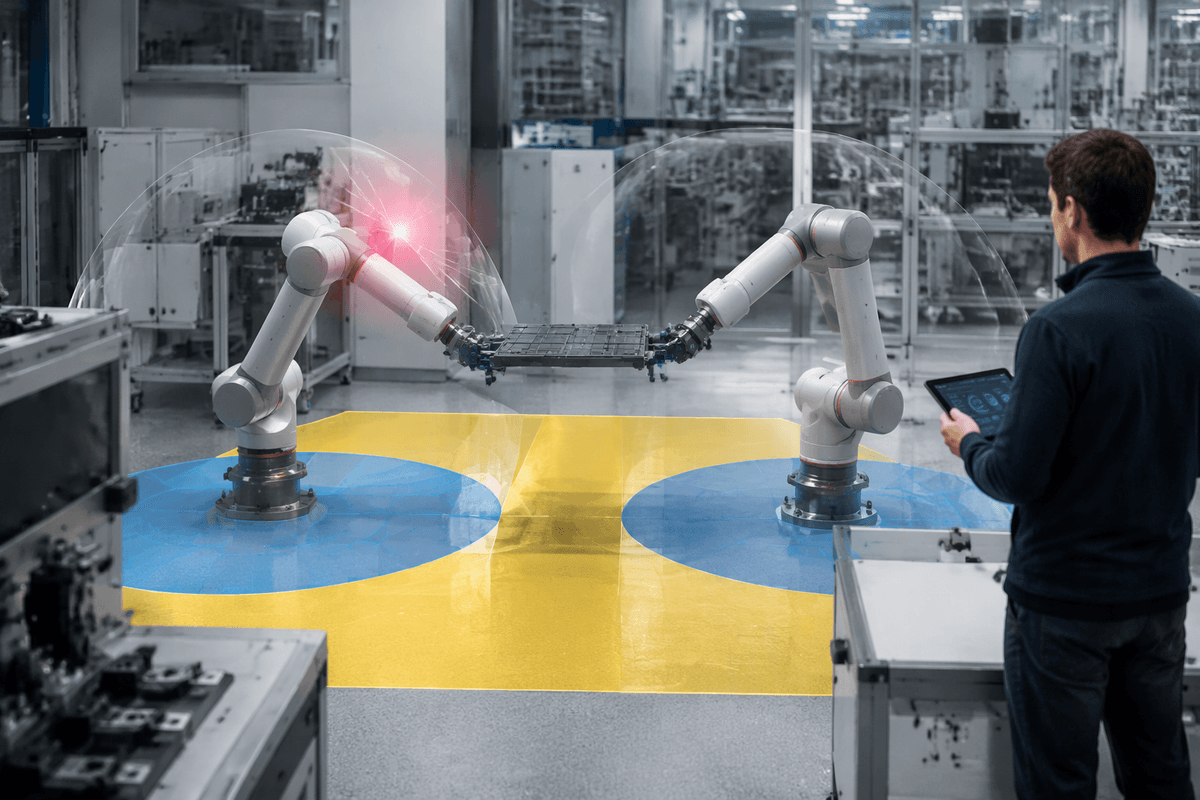
In a real workspace, the question is less “can they coordinate” and more “what happens when one robot is wrong.” Safety usually starts with layered stop behaviors: a fast reflex layer triggered by unexpected contact, excessive joint torque, or a human entering a protected zone, and a slower supervisory layer that decides whether to pause, back out, or hand control to an operator. For tightly coupled tasks, teams often treat the object as the safety reference: if force spikes, the safest response may be “freeze the load” (hold position with compliance) rather than both robots stepping away and dropping it.
Recovery is where systems reveal their maturity. A good controller logs the last agreed-upon state, declares a fault (“lost contact,” “pose disagreement,” “comms timeout”), and transitions to a known-safe posture before attempting re-sync. The practical cost is downtime: conservative fallbacks, human confirmation, and re-calibration can take longer than the original motion, but they prevent small errors from turning into unstable pushes, falls, or damaged equipment.
Putting it together: what to look for in real systems
Watch for whether the system makes commitments explicit: a task decomposed into roles, a shared frame for objects, and a clear tie-breaker when estimates disagree. Ask what gets exchanged in real time—time-stamped state, short-horizon intent, acknowledgments, and health signals—and what happens when messages arrive late or not at all. Robust teams slow down, increase compliance, or pause instead of “pushing through” uncertainty.
Then look at recovery and operating costs. Can it name faults (“lost contact,” “pose drift,” “timeout”) and return to a known-safe posture without an ad hoc reset? How long does re-sync take, and how often does it require an operator or re-calibration? Many demos optimize smooth motion; mature systems optimize bounded failure and predictable downtime.