Why action lists fail without value estimates
A busy action list can look like progress while quietly avoiding the hard question: which items are actually worth doing. Without even rough value estimates, prioritization defaults to loud signals—recent pings, senior requests, visible bugs, or work that feels satisfying to finish. Teams then “manage throughput” instead of outcomes, shipping a steady stream of changes with no shared expectation of payoff.
The failure mode is subtle. You can’t tell if you’re winning, only that you’re moving. Trade-offs become personal preference, not reasoned choice, and you can’t explain why a two-week project beat a one-day experiment. The cost is real: time, attention, and morale get spent on work that never had a credible path to impact.
Define “value” before you try to measure it
Value sounds obvious until two people use it to mean different things. One person means revenue, another means retention, another means risk reduction, and a fourth means “fewer complaints in Slack.” If you don’t name the kind of value you’re chasing, estimates turn into arguments about priorities disguised as math. A product change might be “high value” because it protects renewals, while an engineering rewrite might be “high value” because it reduces on-call load; both can be true, but they compete for the same calendar.
Pick a small set of value definitions you’ll reuse: customer outcome (what improves for whom), business outcome (what moves in dollars or strategic position), and operational outcome (what reduces cost, time, or failure). Then tie each candidate task to one primary outcome and a measurable proxy. Many proxies lag or are noisy, so you’ll need to accept imperfect signals and still commit to a shared definition.
Make assumptions explicit: what must be true to win
You can’t estimate value without also estimating the story underneath it. Most initiatives only look “high value” because of hidden assumptions: customers will notice, they’ll change behavior, sales will message it correctly, the performance work won’t break edge cases, legal will approve, and support won’t get flooded. When those assumptions stay implicit, teams treat disagreement as taste instead of a different view of what’s likely to be true.
Write the assumptions down as “to win, we need…” statements. Keep them concrete and falsifiable: “at least 20% of trial users will hit this feature in week one,” “we can ship without a migration,” “CS can handle the new workflow without extra headcount.” Then mark which ones are most fragile and most important. The practical catch is time: doing this well takes 20–30 minutes per option, but it saves weeks of building on a premise nobody checked.
Use ranges, not point numbers, to stay honest
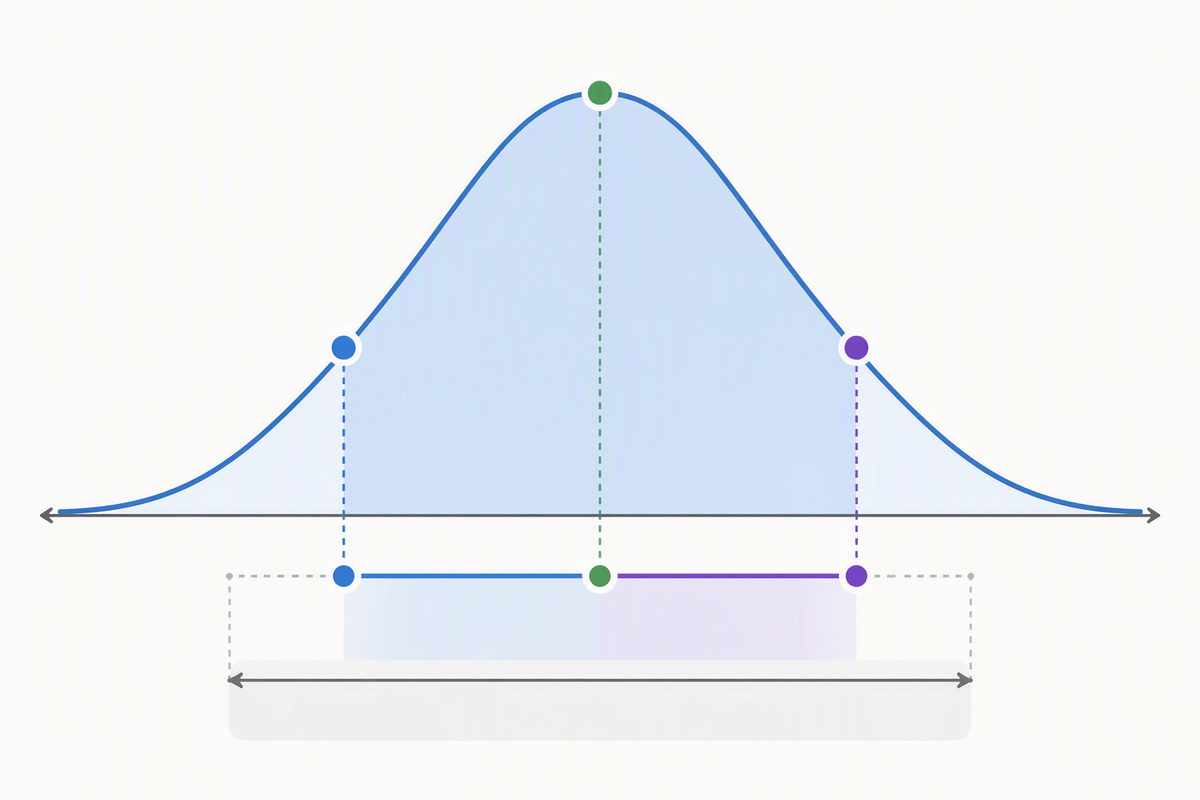
Every planning and review meeting runs through the same familiar beat: someone puts forward a single crisp number — $200k in incremental ARR, a 30% drop in incidents — and the room either nods through approval or digs in to argue. Single-point projections carry a false sense of precision. They also paper over the real question underneath: how wide is the spread of uncertainty, and what would it take for outcomes to land at the low end versus the high?
Ranges work better because they force teams to acknowledge variability explicitly and make tradeoffs visible. Frame estimates across low, mid, and high scenarios — or 10th, 50th, and 90th percentiles — paired with the probability of falling into each band. A forecast of “2–6% conversion lift, most likely around 3%” is far more actionable than a flat “4%”. It calibrates how much investment makes sense, how quickly teams should look for early readouts, and what counts as a below-expectation result.
Ranges can come across as hedging, or even a lack of conviction. Think of them instead as an honesty tax paid upfront, to avoid paying a far steeper price later in rework, misaligned accountability, or unplanned fallout.
Compare options with the same yardstick and timeframe
You’ll still get misleading priorities if every option is estimated on its own terms. One pitch uses annual revenue, another uses “strategic,” a third uses hours saved per week, and a fourth uses “this will reduce incidents.” The fix is boring but powerful: force everything onto the same yardstick and the same time window. Pick a primary outcome and express each option as expected impact over a defined horizon (for example, “expected net value in the next 90 days” or “12-month value, discounted for uncertainty”). Then translate proxies into that frame: hours saved become cost avoided; risk reduced becomes expected loss avoided; retention improvements become expected revenue protected.
Also align the readout window. A platform investment may pay back in 9–18 months, while a pricing test shows signal in two weeks. If you compare them without a shared timeframe, you’ll unintentionally reward whatever produces fast proof, not what produces the best outcome. Some conversions will be rough, but rough-and-consistent beats precise-and-incomparable.
Balance value against cost, delay, and reversibility
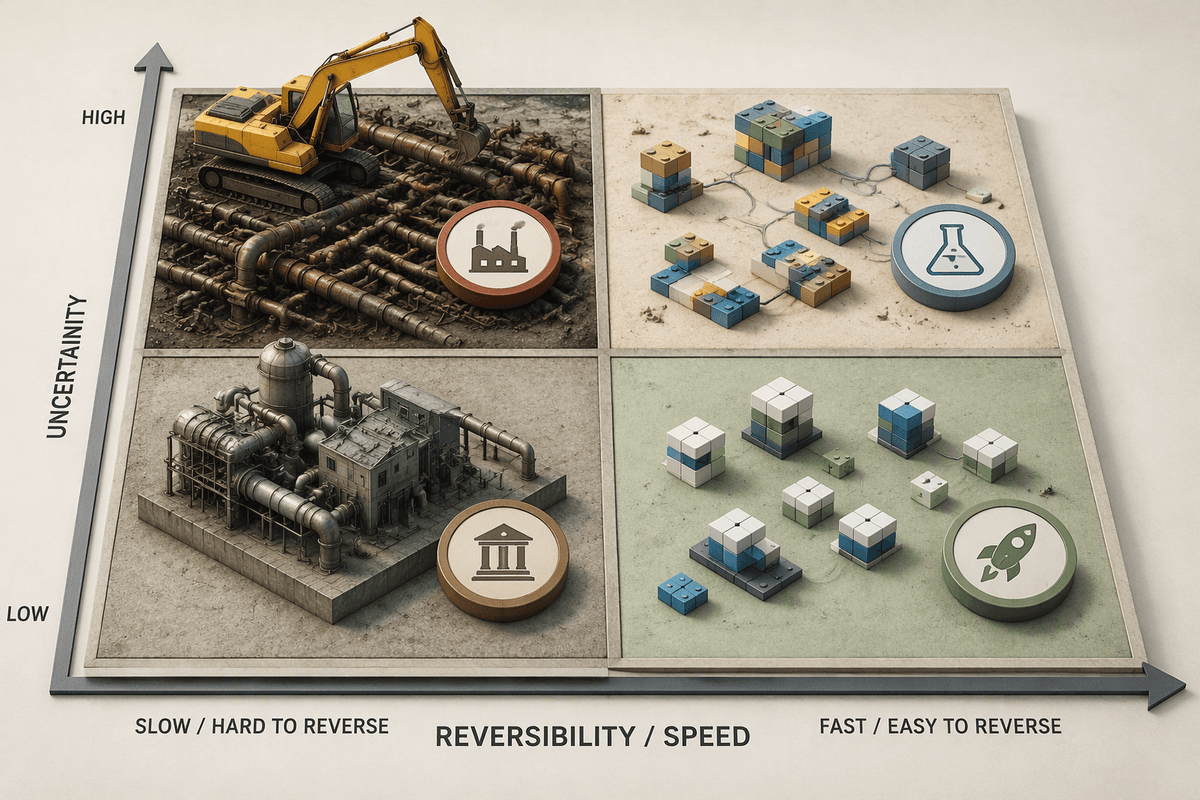
Two options can have the same expected value and still be very different bets. A feature might plausibly drive meaningful adoption, but require six engineer-weeks, coordination with marketing, and a risky migration. Another option might be a two-day experiment that only has a modest upside, but produces a clean learning signal and can be rolled back in minutes. When you ignore cost and delay, you accidentally bias toward “big projects with big stories,” even when the opportunity cost is brutal.
Put four numbers side by side for each option: expected value, expected cost (including coordination and on-call risk), time to first trustworthy read, and reversibility (how expensive it is to undo or recover). Favor work that is fast to validate and easy to reverse when uncertainty is high, and reserve slow, hard-to-reverse moves for situations where the upside is large and the assumptions are already de-risked. The practical constraint is that reversibility often isn’t free; building safe rollbacks, feature flags, and migration paths can add real time, but it also changes what you can responsibly attempt.
Turn estimates into a learning loop, not a debate
You don’t “win” by defending an estimate; you win by updating it. When you choose an option, write down the range, the key assumptions, and what evidence will change your mind—then schedule the check. A two-week build should have a concrete readout date, a metric threshold, and a pre-agreed response: double down, iterate, or stop. This prevents sunk-cost autopilot and keeps disagreement focused on what to test next, not who was right.
Instrumentation takes time, and results are often noisy. Still, even a lightweight cadence—weekly estimate updates with notes on what you learned—turns prioritization into compounding judgment.