Why drug discovery in space is suddenly on the table
Ten years ago, “drug discovery in space” mostly sounded like a publicity stunt: limited launch slots, bespoke hardware, and long timelines made it hard to justify against well-equipped Earth labs. The tone shifted as routine cargo runs to the International Space Station, small satellites, and commercial spaceflight made it more realistic to send compact experiments repeatedly rather than as one-off showcases.
At the same time, pharma has been squeezed by expensive late-stage failures, so even small chances to see biology behave differently—especially in ways that clarify targets or improve protein crystals—are worth testing. AI adds a practical push by helping decide which few experiments deserve the cost, not just by crunching the results afterward.
What microgravity changes in cells, proteins, and crystals
On Earth, gravity constantly pulls on fluids and soft tissues, which drives settling, convection, and shear forces you rarely notice until you try to remove them. In microgravity, cells experience different mechanical cues, nutrients and signaling molecules diffuse differently, and buoyancy-driven mixing largely disappears. That can shift gene expression, stress responses, and how cells organize into 3D clumps or tissue-like structures—useful when a flat dish hides behaviors that matter in a real organ. The catch is that “different” doesn’t mean “more human,” and the same cell line can respond differently depending on hardware, timing, and even launch conditions.
Proteins and crystals are the other big draw. With less sedimentation and gentler fluid motion, some proteins can form larger, more orderly crystals, which can improve structure determination and, downstream, structure-based drug design. But the upside is inconsistent: many proteins still refuse to crystallize, and every space run is expensive, slow to iterate, and constrained by tight mass, power, and temperature control.
Where AI fits: picking experiments, not just analyzing results
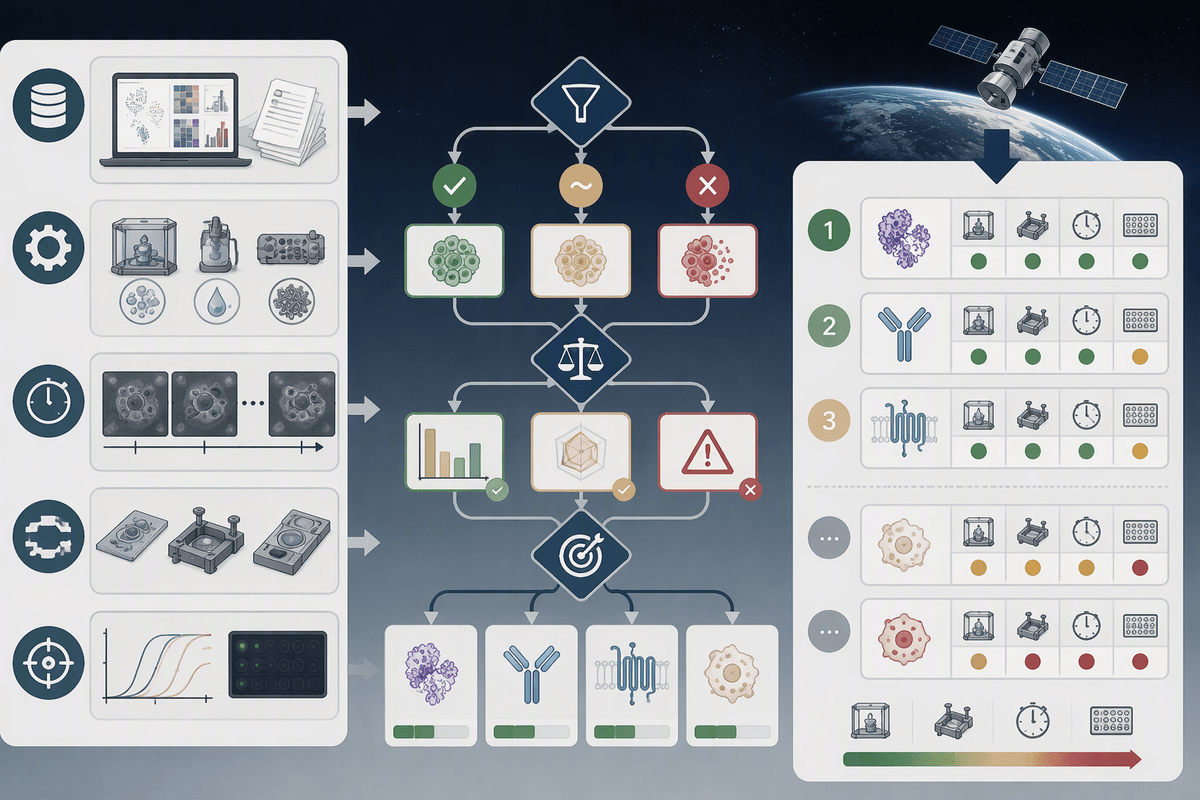
A familiar pattern in early drug research is that you can run a hundred reasonable experiments and still feel unsure which result actually mattered. Space makes that “which one is worth it?” problem much sharper, because you might only get a handful of samples, a few time points, and one shot at a specific temperature profile or imaging setup. AI is most useful before anything launches: narrowing the menu to experiments that are both scientifically informative and feasible inside a cramped, power-limited payload.
That looks less like a magic model “discovering drugs” and more like decision support. Given prior ground data, known failure modes in microgravity hardware, and what measurements are possible (imaging cadence, fixation methods, assay sensitivity), AI can help rank targets and conditions that are likely to produce a clear readout: a protein that plausibly crystallizes under a limited screening matrix, or a cell model where 3D organization is a meaningful proxy for patient biology. The training data for “what works in space” is thin and inconsistent, so the system’s best contribution is often triage and experiment design, not confident prediction.
The data problem: tiny sample sizes and messy controls
In a normal lab, if an assay is noisy you rerun it, add replicates, and tweak one variable at a time. In orbit, you often fly a small number of samples because every extra well plate, camera frame, or reagent cartridge costs mass, power, cold storage, and crew handling. That pushes studies toward “n=small,” limited time points, and opportunistic readouts—exactly the conditions where apparent effects can be real, but hard to separate from drift, batch effects, or a single failed pump.
Controls are also messier than they sound. A ground control is not the same environment: it misses launch vibration, radiation, microgravity-specific fluid behavior, and the in-flight temperature history. Even “1g” centrifuge controls onboard can differ in subtle ways from nearby microgravity samples because they live in different hardware and experience different mixing and shear. AI can help by modeling these nuisance factors and flagging inconsistent runs, but it cannot conjure statistical power that wasn’t designed into the mission.
Practical bottlenecks: hardware limits, automation, and crew time
Anyone who has tried to troubleshoot a finicky lab robot will recognize the problem: space hardware has to be smaller, tougher, and more “set-and-forget” than most benchtop systems. Payloads face tight mass and volume caps, limited power, strict thermal control, and long periods where you can’t just open a lid and swap a tube. Consumables become the hidden constraint—reagent stability, bubble formation in microfluidics, and contamination risk can end an experiment even if the biology was sound.
Automation helps, but it isn’t free. Reliable fluid handling, sterile loading, and imaging that works unattended for days demands custom engineering and extensive ground validation, which can cost more than the experiment itself. Crew time is another bottleneck: astronauts have competing priorities, and “simple” steps like mixing, fixing, or moving samples take longer in gloves, with checklists, and with limited opportunities to repeat a mistake. AI can reduce wasted runs by designing protocols that tolerate these constraints, but it can’t remove them.
Where space-AI could pay off first: three plausible use cases
A realistic first win is better protein structures with fewer wasted shots. If a payload can only test a small crystallization screen, AI can pick conditions that cover the most informative parts of chemical space, then adapt the follow-up plan on Earth based on what actually grew. The payoff is incremental but concrete: clearer electron density can shorten the “is this binding mode real?” loop, even if it doesn’t make stubborn proteins behave.
A second use case is stress-testing disease models where microgravity reliably pushes cells into 3D organization or altered immune-like signaling. AI can help choose which cell types, time points, and readouts are likely to separate competing hypotheses about a target—especially when crew time limits you to a few imaging windows and end-point assays. Many “space effects” are context-dependent, so models must be framed as decision aids, not general biology claims.
A third is hardware-aware experiment design: treating fluidics failures, temperature drift, and assay sensitivity as first-class variables. AI can rank protocols by expected information per gram, per watt, and per minute of crew handling, which is often the difference between a publishable result and an ambiguous one.
How to judge a “space drug discovery” claim responsibly
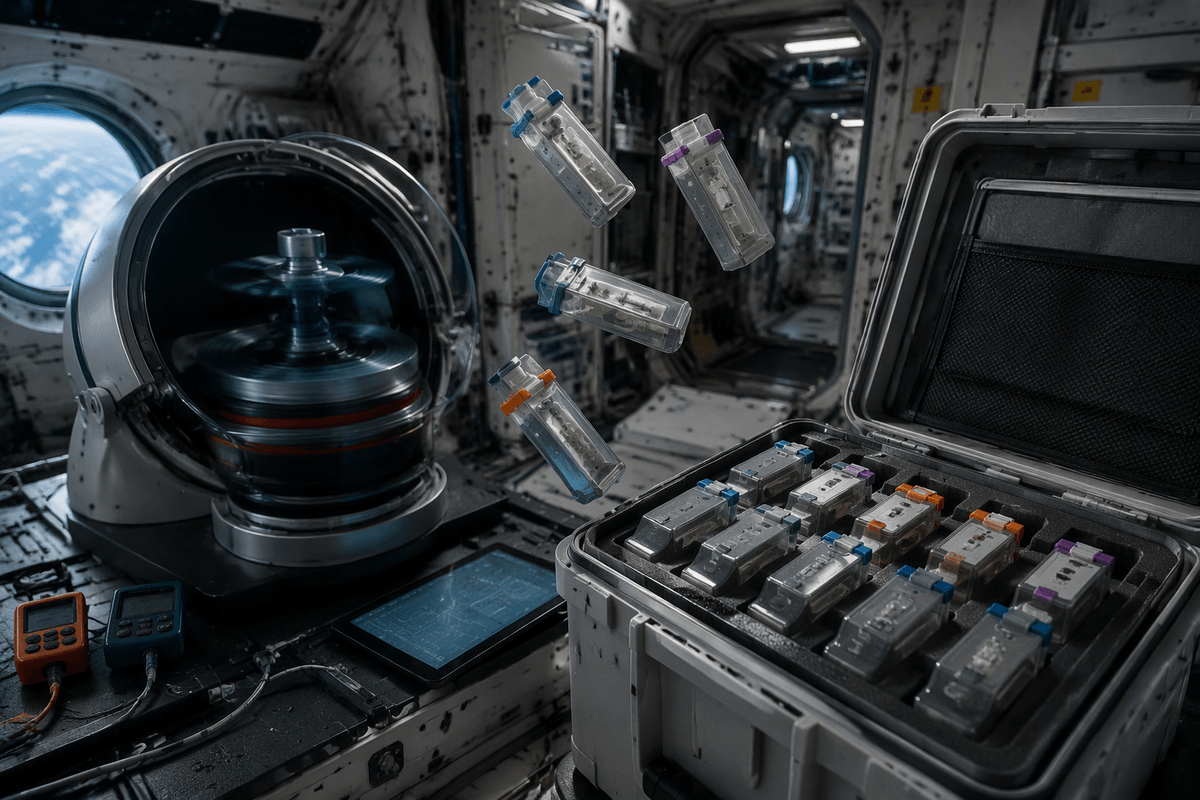
A press release might say “microgravity accelerates discovery,” but a responsible read starts with basics: what was the comparison, and was it fair? Look for matched controls (ideally an on-orbit 1g centrifuge plus a carefully tracked ground control), clear sample counts, and whether the reported effect survives batch differences like launch timing, temperature history, and hardware changes. If a result relies on a single flight or a single cell line, treat it as a lead, not a conclusion.
Then ask what the space result actually changed downstream. Better crystals matter if they produced a higher-resolution structure that changed ligand design choices, not just a nicer picture. A “different gene expression profile” matters if it predicts something testable on Earth, like a target-response relationship or a toxicity signal. With AI, the key question is whether the model improved decisions under constraints—fewer failed runs, better condition selection, clearer go/no-go calls—not whether it produced an impressive plot after the fact.
So, could it work—and what would make it worth it?
Whether it “works” depends on a modest standard: space should produce information you cannot get as cleanly on Earth, and that information should change a downstream decision. The most defensible wins look like a protein structure that resolves an ambiguity that was blocking chemistry, or a microgravity-driven tissue-like behavior that reveals a target liability before years of animal work. AI matters when it reduces wasted flights by picking experiments that are robust to drift, limited sampling, and hardware quirks.
To be worth it, the program needs repeatable pipelines: standardized payloads, logged environmental histories, on-orbit and ground controls, and pre-registered analysis plans. The main cost is not only launch; it’s the slow iteration cycle, custom engineering, and the risk that a single valve or temperature excursion turns a mission into an anecdote. If those frictions don’t shrink, space remains a niche tool, not a general shortcut.