Why running is harder than walking for humanoids
You’ve probably seen a humanoid “run” in a short demo: a few quick steps on a flat surface, maybe on a tether or with a safety rig nearby. That same robot often struggles to keep the pace for minutes, let alone an hour, because running forces a different physics problem. Walking always has at least one foot on the ground, which gives the controller time and contact to correct errors. Running includes a flight phase where neither foot touches the ground, so small timing or placement mistakes can’t be fixed until the next impact.
Those impacts are the other big jump in difficulty. Each landing sends large, fast shock loads through feet, ankles, knees, hips, and the gearbox or transmission that drives them. Humans rely on compliant tendons and muscles to store and return energy while also damping vibrations; most robots do this with motors, gears, springs, and software, which can be heavier, less forgiving, and harder to tune. The price shows up as higher peak power demand, faster heating, more wear, and a narrower margin for balance—especially once the ground isn’t perfectly predictable.
Staying upright at speed: balance through every stride
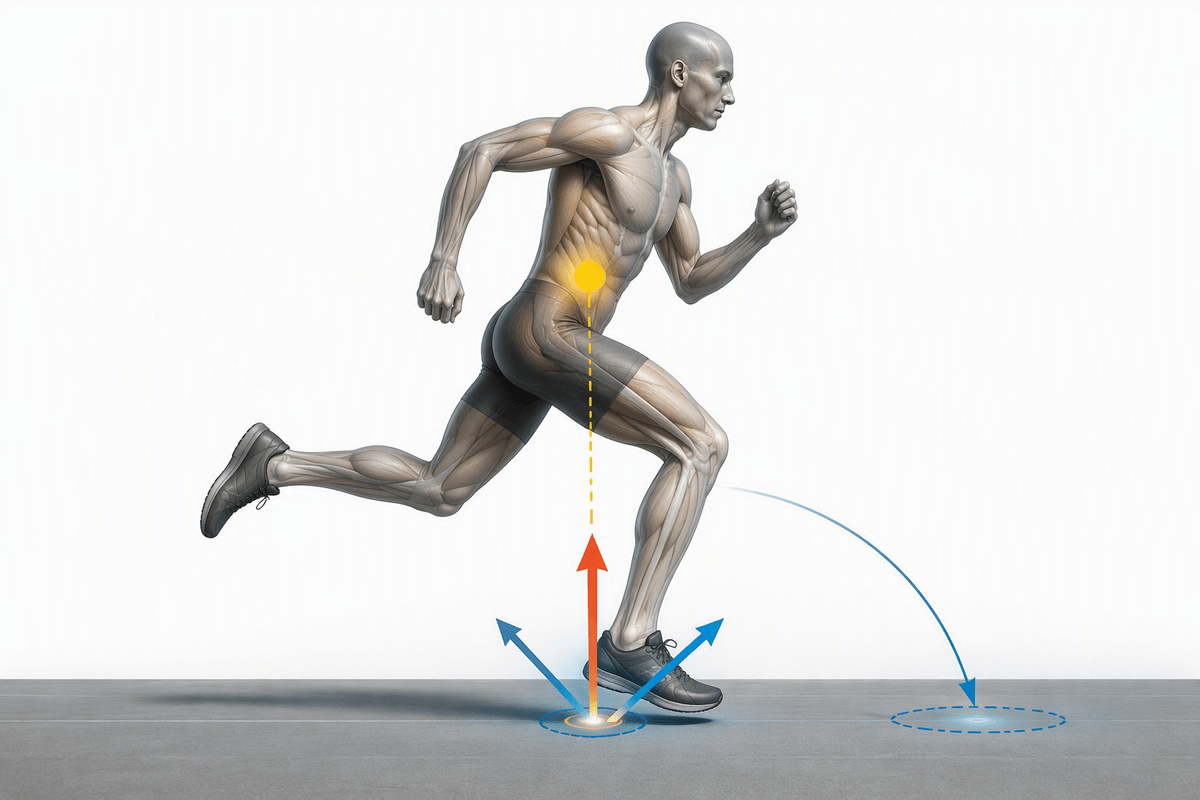
Picture the moment your foot hits the ground while sprinting for a bus: you’re slightly off-line, but you recover by placing the next step where it needs to be. A humanoid runner has to do the same thing, except it only “gets a vote” at each brief contact. At speed, stance time shrinks to fractions of a second, so the robot must estimate its body state (tilt, rotation, velocity) and decide the next foot placement before the window closes. If it’s late, it can’t “lean on” a planted foot the way it can when walking.
The controller also has to manage angular momentum from swinging legs and arms, and it must do it while impacts jolt sensors and flex the structure. Real surfaces add another constraint: tiny height changes, soft patches, or a slightly slippery spot can turn a safe step into an unrecoverable one unless the robot has enough lateral authority—hip torque, ankle control, and friction margin—to correct within one or two strides.
Legs, joints, and feet that survive repeated impacts
Watch a runner’s shoes after a few hundred miles: the foam compresses, the tread wears down, and small alignment issues start to show up as sore knees or ankles. A humanoid has the same problem, except its “bones” are brackets and housings, and its “tendons” are elastomers, springs, belts, and gear trains that can fatigue or loosen. Each landing concentrates force into a short impulse, and that impulse repeatedly loads bearings, harmonic drives or planetary gears, and fasteners in ways that walking usually avoids. Even if nothing breaks, tiny amounts of backlash and compliance shift joint timing, which makes balance harder and pushes the controller to work even faster.
Feet are a bottleneck because they set the contact patch, friction, and shock path. Soft soles help with shock and grip, but they waste energy and heat up; stiff soles return energy but transmit harsher loads into joints. Adding real ankle compliance can protect hardware, yet it increases mechanical complexity, mass, and maintenance—exactly the trade-off that turns a convincing 20-second jog into an unreliable long run.
Power and endurance: batteries, motors, and energy return
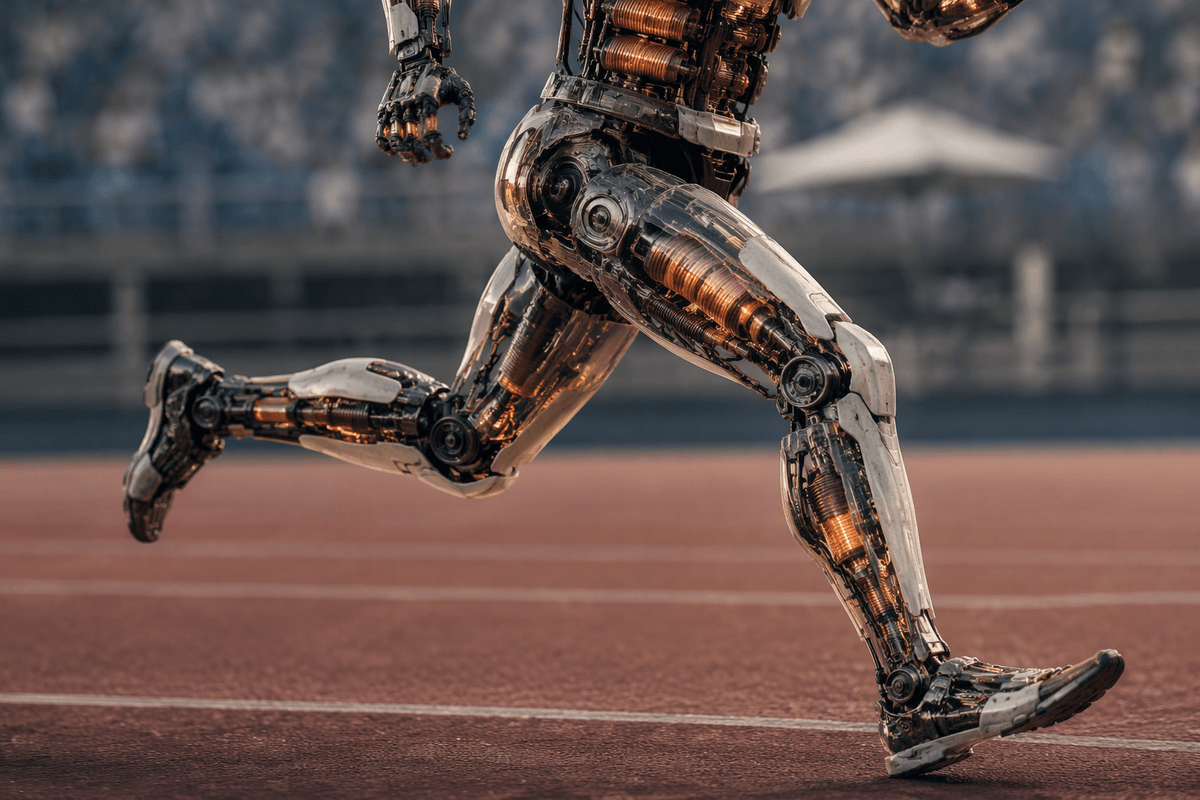
Think about how your phone battery drops faster when you record video: running does something similar to a humanoid, because the joints don’t just need steady energy, they need repeated bursts of high power. Motors and gearboxes have to deliver strong push-off and then handle regeneration or braking on landing, and both directions create losses. Those losses show up as heat in copper windings, inverters, and gears, so “enough battery” isn’t the whole story; the robot also needs a powertrain that can survive high current without overheating or derating.
Humans get a big discount from elastic energy return: tendons store energy during landing and give much of it back at toe-off. Robots can add springs, compliant ankles, or series-elastic actuators to mimic that, but every added mechanism costs mass, volume, and tuning effort. A heavier robot needs more energy per mile, which forces a bigger battery, which makes it heavier again. Even with good regeneration, the practical limit is often peak power and thermal headroom, not just total watt-hours on paper.
Heat, wear, and maintenance over an hour-plus run
Anyone who’s used a power tool hard for ten minutes has felt it: the housing gets hot, performance drops, and you start taking breaks to avoid burning it out. A humanoid doing an hour-plus run fights the same reality across dozens of tightly packed heat sources—motor windings, inverters, batteries, and gearboxes—while its body shell limits airflow and adds insulation. If any joint hits a thermal limit, control software has to reduce torque, which can quietly turn “can run” into “can’t catch itself” on the next awkward landing.
Long runs also turn small losses into maintenance. Dust and grit work into seals, lubrication thins under heat, and repeated micro-impacts loosen fasteners and shift alignment. Softer foot materials that protect joints can heat up and abrade; stiffer designs protect efficiency but transmit sharper shocks into bearings and gears. If a robot needs a cool-down and a re-torque every few miles, endurance running is more demo than capability.
Sensing and planning fast enough for real-world paths
Even if the mechanics are perfect, real running fails when the robot can’t “see” the next step quickly and reliably. At jogging speed, a small rock, a curb edge, or a dip that’s a few centimeters deep needs to be detected, localized, and turned into a foot placement decision within a stride or two. That means fusing IMU data with cameras or lidar while the head and torso shake, the view blurs, and impacts inject noise into measurements. If perception drops frames or drifts, the controller may place the foot where the map says the ground is—not where it actually is.
Planning also has to be opportunistic. Humans shorten a step, widen stance, or accept a slight speed loss to stay upright. Many humanoid demos depend on preplanned footsteps on predictable terrain; outdoors, that approach breaks unless the robot can replan under tight time budgets without overfitting to a noisy estimate. Faster compute helps, but the constraint is end-to-end latency, and adding sensors, processing, and protective housings increases mass and power draw—exactly what endurance running can’t spare.
What milestones matter before robots run like humans
You can treat “humanlike running” as a checklist, not a single breakthrough. A real milestone is a robot that can hold a steady pace for 30–60 minutes while keeping joint temperatures below derating limits, without footstep scripts or a safety tether. Another is durability: thousands of high-impact strides with predictable wear, quick inspections, and parts that don’t need constant re-torquing or gearbox swaps. The perception milestone is boring but decisive: reliable curb-and-gravel handling at speed, with low-latency state estimation through impacts. Until energy density, cooling, and service intervals improve together, long runs will stay short and staged.