Why “balanced AI” feels impossible in the news cycle
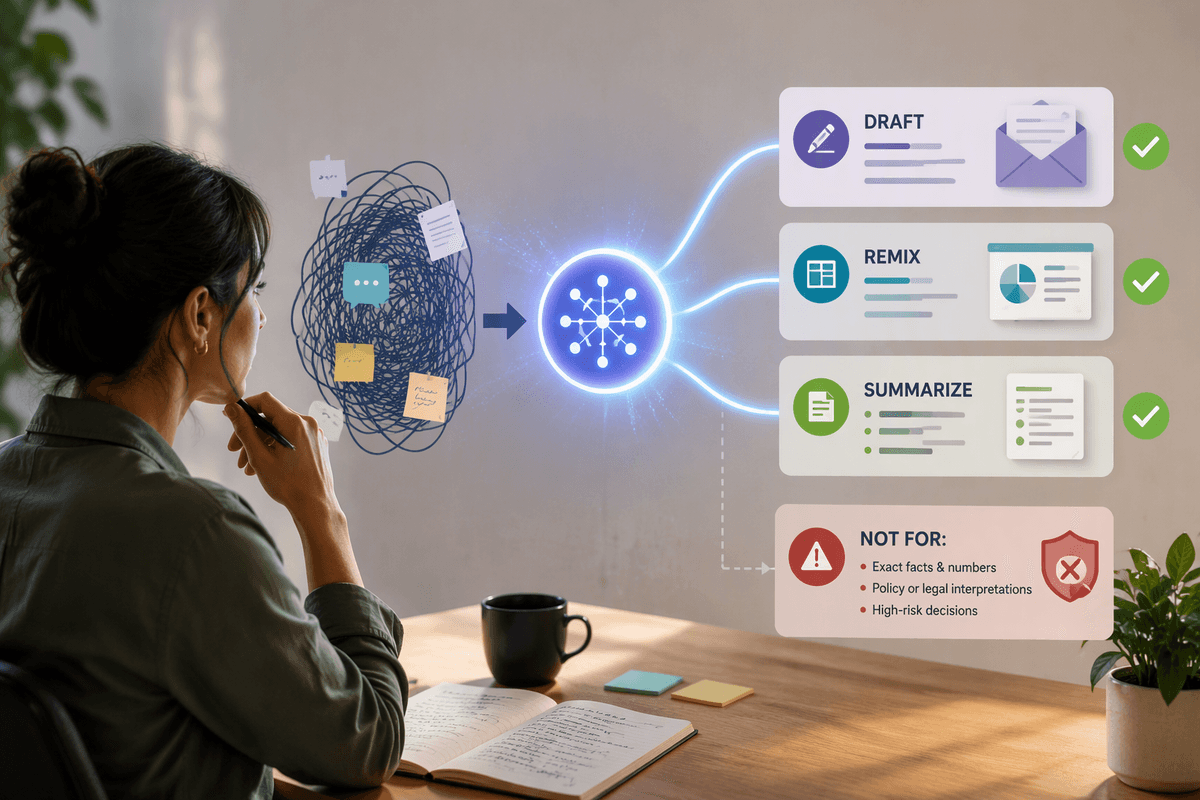
A familiar pattern plays out whenever a new AI system makes headlines: one week it is framed as a breakthrough that will remake work, and the next it is treated as a looming threat that can’t be controlled. “Balanced” takes effort, and the news cycle rewards speed, certainty, and strong angles. That pushes careful questions—where it works, where it fails, who bears the cost—out of the frame.
AI also resists simple scoring because it behaves differently across contexts. A tool that drafts routine emails well can still stumble on a medical form or a legal citation, and those errors are not interchangeable. Meanwhile, the most important effects often appear slowly: workload shifts, new gatekeeping, quiet quality drift. Investigating those takes access to workflows, data, and time—things that are expensive, messy, and rarely available on deadline.
Start with real use cases, not model demos
A model demo is designed to look smooth: a clean prompt, a tidy answer, and no one asking what happened after the text appeared on screen. Real use cases are messier. They include intake forms that arrive half-complete, policies that change mid-quarter, and people who copy, paste, and revise outputs under time pressure. If you want a grounded view, start by naming a specific job the system would do—triaging support tickets, translating short notices, summarizing meeting notes—and the decision that follows from its output.
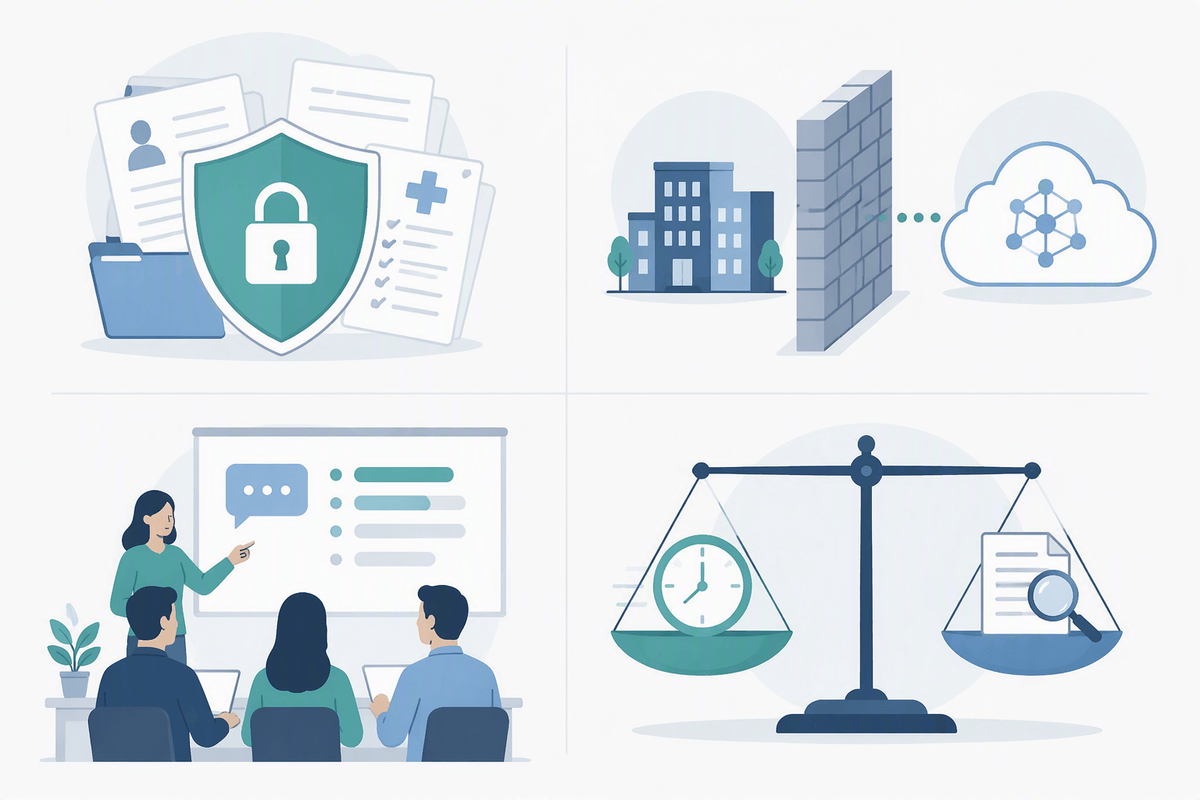
That framing forces practical questions that demos skip: what “good” looks like, what errors are acceptable, and who catches mistakes. It also exposes constraints: privacy rules may block sending data to a vendor model, staff may need training to write prompts and verify results, and the time saved in one step can reappear as review time later. When a claim is tied to a workflow, you can test it with real inputs, real reviewers, and clear success criteria.
What counts as evidence—and what doesn’t
Picture a vendor telling you their assistant is “more accurate than humans,” backed by a chart from an internal benchmark. That is not useless, but it is not evidence of impact in your setting. Benchmarks often measure narrow tasks under controlled prompts, not the messy mix of edge cases, interruptions, and downstream consequences that define real work. Testimonials and “we tried it and liked it” pilots also mislead when they skip the denominator: how many cases were reviewed, what kinds of errors appeared, and what happened when the tool was wrong.
Evidence that travels is specific and audit-friendly: side-by-side comparisons on your own data; a clear rubric for quality; error rates by category (not just an average); and traces of what changed in the workflow (cycle time, rework, escalations, complaints). It should include failure examples, not just wins, and show who did the checking. The practical constraint is cost: collecting labeled samples, paying reviewers, and running evaluations takes time and money, which is why many claims stay vague.
Benefits you can measure: time, quality, and new access
When AI adds value in real deployments, it usually shows up in a few measurable places. One is time: fewer minutes spent drafting first versions, tagging documents, or routing requests. Don’t settle for “it feels faster.” Track cycle time from intake to completion, and separate “production time” from “review and rework,” because savings often move rather than disappear.
Quality gains can be real, but they tend to be uneven. A tool might reduce missing fields in a form, improve consistency in tone, or catch common issues in long text, while still failing on rare but consequential cases. Measure quality with a rubric and sample across easy, typical, and edge inputs, then look at error types, not just averages. The third benefit is new access: translations that make notices usable, summaries that let staff scan more material, or better search over internal policies. The access features often require careful privacy and permissions work to be safe.
Risks that show up in deployment, not slide decks
A common deployment surprise is that the biggest risks are operational. The model may be “accurate on average,” yet still produce rare mistakes that trigger real costs: a support reply that promises the wrong refund, a summary that omits a key condition, a translation that flips a date or negation. Those errors often slip through because people calibrate their trust to the tool’s confident tone, then speed up their checking as volume rises.
Other risks come from integration decisions, not model capability. Logging and analytics can capture sensitive text by default; permissions can be mis-scoped so a search feature exposes documents across teams; and small prompt or policy changes can quietly shift outputs over weeks. Even when you add human review, the work can migrate into new bottlenecks—training reviewers, resolving disagreements, handling appeals, and writing exceptions for edge cases. The practical cost is ongoing: monitoring, incident response, and periodic re-evaluation, not a one-time procurement.
A small pilot can reveal more than big promises

Picture a team that wants an AI assistant for customer support because “it will cut response time in half.” A small pilot replaces that slogan with numbers. Pick one narrow queue, freeze the policy rules for the test period, and run the assistant in a shadow or assisted mode where humans still send the final reply. Track three things at once: time from ticket open to first draft, time spent reviewing and editing, and the rate of escalations or reopens. The goal is not to prove the tool is “good,” but to locate where it helps and where it creates rework.
A pilot also surfaces the unglamorous details that determine whether deployment is viable. You learn which inputs are too messy to automate, which error types are unacceptable, and whether staff actually follow the checking steps under real volume. You also discover costs that slide decks rarely price in: preparing safe data, setting up access controls, paying for review time, and handling edge-case disputes. If the pilot can’t produce a stable workflow with clear failure handling, scaling will usually amplify the problems, not solve them.
Decide with thresholds, monitoring, and an exit plan
Imagine the pilot looks “mostly good,” but the remaining errors cluster in the few cases that cause refunds, compliance issues, or public embarrassment. That is where thresholds matter. Decide in advance what you will tolerate: maximum critical-error rate, maximum time added by review, minimum quality lift, and a clear scope of allowed tasks. Put monitoring where work actually breaks—spot checks on edge cases, drift tests after prompt or policy changes, and a lightweight incident log tied to outcomes, not anecdotes.
Then make the exit plan real. Define what triggers rollback (a spike in complaints, a privacy incident, repeated failure modes), who can pause the system, and how humans take over without chaos. Monitoring costs time and attention; if you cannot fund that ongoing work, treat “don’t ship” as the responsible option.