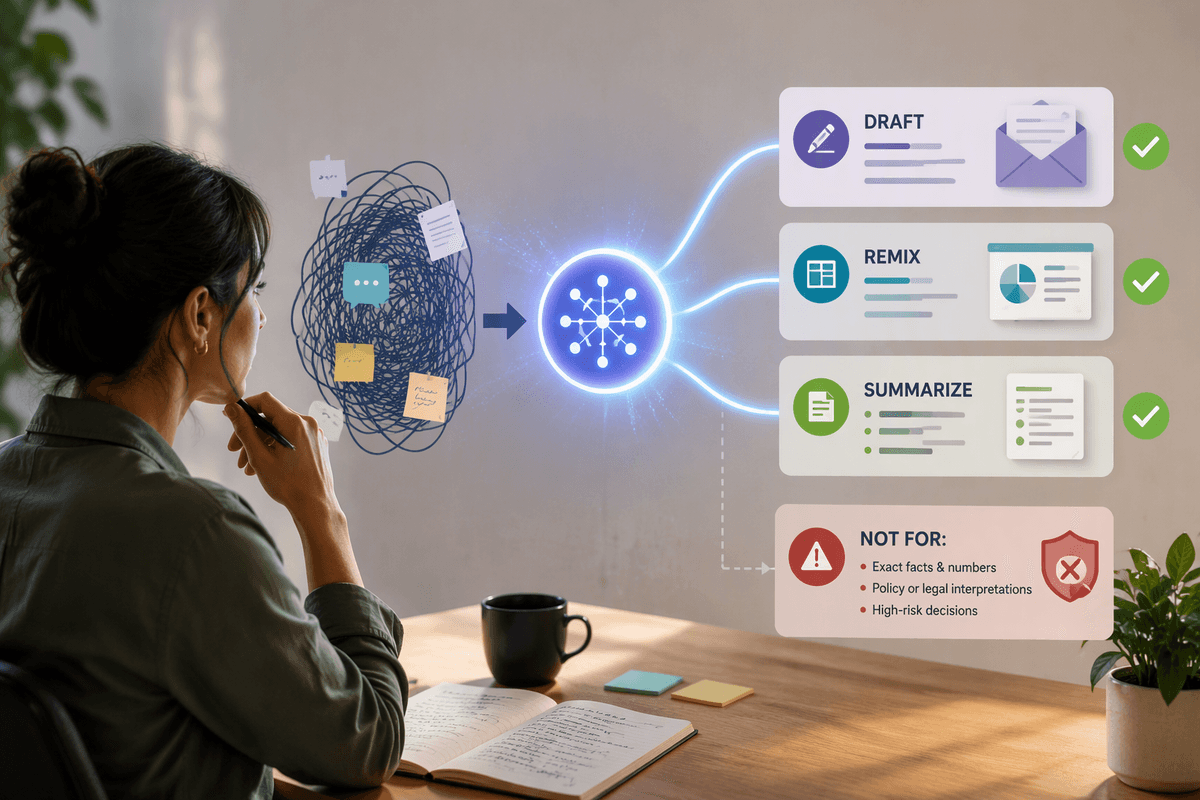
Why the AI job panic feels so convincing
It’s easy to believe AI will erase whole jobs because the demos feel like magic: a chatbot drafts an email, writes code, summarizes a meeting, and suddenly it looks like “the work” has been solved. Headlines amplify that impression by turning a capability into a headcount prediction, even though most roles are bundles of tasks spread across tools, people, and deadlines. Anxiety also spreads socially. If a manager mentions “efficiency,” employees hear “cuts,” and the uncertainty does the rest. The most convincing claims are also the vaguest: “AI will replace you” is simpler than explaining which tasks change, who signs off, and what quality failures cost.
What actually changes when a task gets automated
Think about a typical week: you don’t “do a job,” you move a queue of tasks from messy to done—drafting, checking, routing for approval, following up, documenting decisions. When one of those tasks gets automated, the first change is usually speed and volume, not disappearance. The output becomes cheaper to produce, so expectations rise: more drafts, more variants, faster turnaround. That often shifts the scarce work to what sits around the automated step—deciding what to ask for, feeding clean inputs, catching edge cases, and explaining results to someone who owns the risk.
Automation also changes where errors show up. If a tool is wrong 5% of the time, the cost isn’t “5% less productivity,” it’s the time spent finding and fixing the wrong 5%, plus the reputational hit when it slips through. That pushes roles toward review, judgment, and coordination, even when the core task looks “solved” in a demo.
Jobs most exposed: high-volume, low-ambiguity work
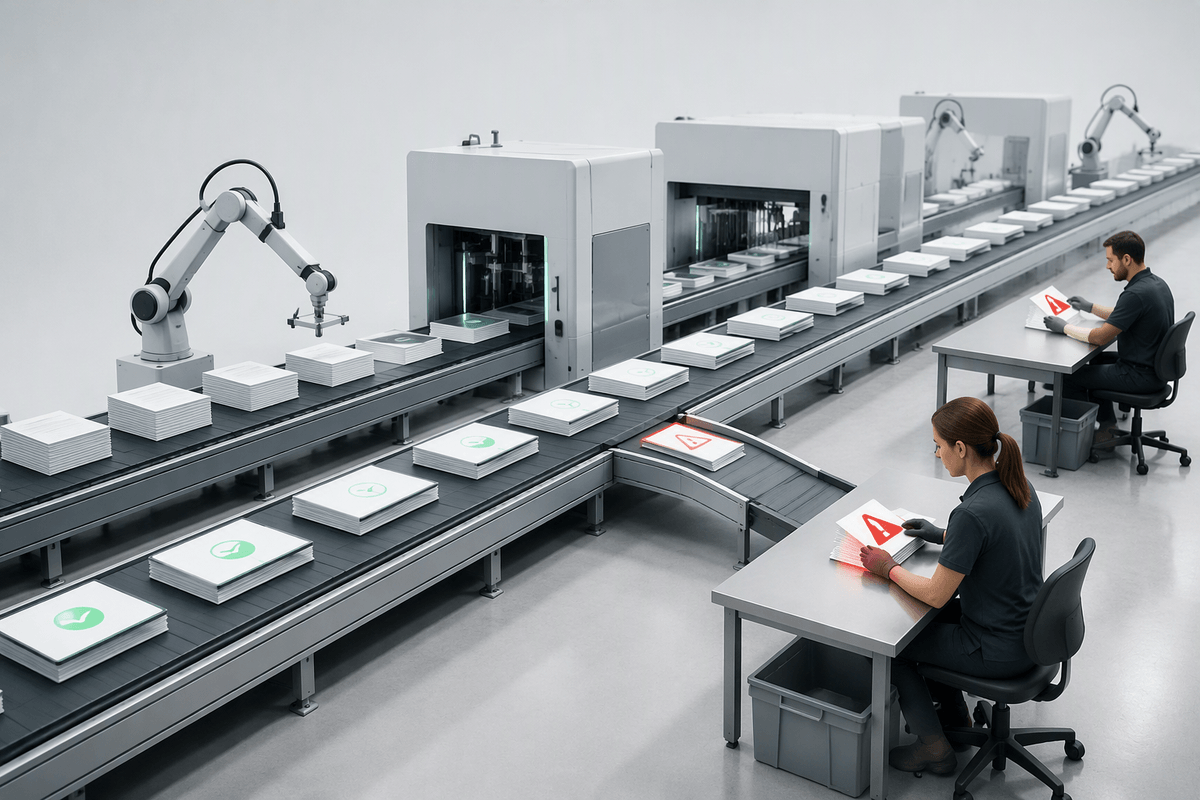
You can usually spot the most exposed work by looking for two traits: high volume and low ambiguity. If a task comes in a steady stream, follows a consistent format, and has a clear “good enough” target, automation tends to bite harder and faster. Think of triaging routine support tickets, generating standard sales outreach, drafting basic product descriptions, converting meeting notes into action items, or producing first-pass reports from structured data. The point isn’t that these activities vanish overnight; it’s that fewer people are needed to push the same queue through.
That shift shows up first as consolidation. One person with decent tools can handle what used to take a small team, especially when quality is measured by speed, coverage, and template compliance. The real-world inputs are messy—bad data, unclear requests, and exceptions—so organizations still pay for humans where mistakes create rework, refunds, or compliance risk.
Jobs that persist: accountability, trust, and messy context
Picture the work you can’t “just ship” without someone owning the downside: approving a hiring decision, signing a financial close, interpreting a regulation for a new product, or telling a customer what the company will do when something breaks. These roles persist because the core output isn’t text or analysis; it’s a decision that has consequences, and a relationship that absorbs uncertainty. AI can draft options and surface risks, but it can’t be the person who’s accountable when the judgment call goes wrong.
Trust also depends on context that rarely lives in one place: the history behind a client’s complaint, the politics of a cross-team trade-off, the unwritten expectations of a leader, the local constraints that make a “best practice” unrealistic. That messy context is why experienced managers, senior ICs, clinicians, auditors, and project owners stay valuable. The practical limitation is cost: careful review, documentation, and stakeholder alignment take time, so organizations use AI to accelerate preparation while keeping humans responsible for the final call.
The middle reality: fewer openings, different expectations

You’ll often feel AI’s impact less as layoffs and more as a hiring slowdown. When a team can produce the same weekly output with fewer hours—because drafts, summaries, tickets, or analyses are faster—leaders tend to delay backfills, combine roles, or push work into shared-service queues. That translates into fewer entry points and longer time-to-hire, even if the org chart looks stable. It can also widen the gap between “junior” and “useful,” because the easiest-to-automate tasks were the ones that used to train new people.
Expectations shift in two directions at once: more throughput and more judgment. A marketer isn’t just writing copy; they’re running rapid variants, checking claims, and defending choices with data. A data analyst isn’t just building charts; they’re validating sources, explaining assumptions, and catching when a model answer conflicts with business reality. The review and coordination become the bottleneck, and not every team can afford the slower, safer way of working.
How to tell hype from impact in your industry
If you want to judge AI’s impact in your field, start with where the work actually lives: your ticketing system, CRM, backlog, close checklist, or editorial calendar. Count the tasks that repeat with the same inputs and outputs, then ask who currently does the first draft, who reviews it, and what happens when it’s wrong. Hype talks about “replacing roles.” Impact shows up as a changed workflow: fewer handoffs, shorter cycle time, and a shift in what gets escalated to humans.
Track signals that are hard to fake. Are job postings quietly dropping requirements like “2–3 years of copywriting” and adding “can supervise AI-assisted output”? Are managers measuring throughput per person, not headcount? Are error costs moving—more time spent on QA, compliance review, customer remediation, or rework? Most professionals don’t see company-wide metrics, so use what you can observe—queue size, turnaround time, and which tasks keep bouncing back for clarification—as your early warning system.
A pragmatic plan: reduce risk without chasing every trend
Most people don’t need a dramatic pivot; they need a tighter loop between what they produce and what the business risks. Pick one recurring workflow you touch—tickets, reports, proposals, lesson plans—and deliberately move “upstream” and “downstream”: clarify inputs, define acceptance criteria, and own the review step where mistakes get expensive. Learn one tool well enough to save real hours, then document the process so you become the person others rely on to run it safely.
Keep your radar practical: watch hiring volume, backfill decisions, and which tasks are being bundled into “one role.” The cost is time—building judgment, domain context, and stakeholder trust is slower than learning prompts, but it’s the part automation can’t buy overnight.