Why “AI agents” feel new, but aren’t magic
Most “AI agent” demos look like a single system that can read, decide, and act. That feels new because the output is conversational, but the underlying pattern is familiar: a loop that observes state, chooses an action, executes it, and checks results. The “agent” label usually means you’ve added components around a language model so it can do work beyond replying—calling tools, writing to a queue, updating records, or triggering workflows.
What’s not magic is the trade-off: every added capability also adds cost, latency, and failure modes. If you can’t explain which step produced a bad outcome, you don’t have an agent problem—you have an architecture problem.
The core engine: language models as reasoning interfaces
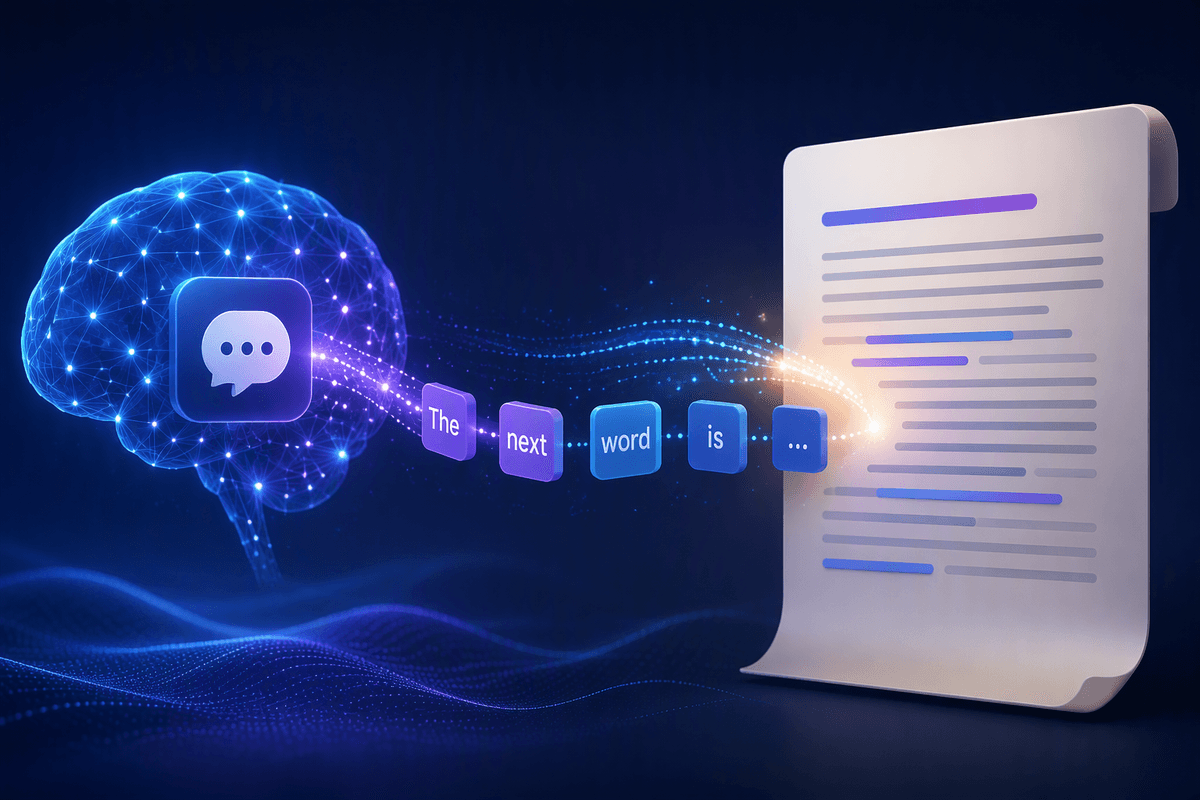
A familiar pattern shows up when you watch an agent “think”: it reads a chunk of context (instructions, user input, current state), produces a candidate next step, then repeats. The language model is the engine inside that loop, but it’s best understood as a reasoning interface rather than a database of truth. It’s good at turning messy inputs into structured outputs—classifying, extracting fields, drafting a plan, proposing an action—and explaining the rationale in plain language when asked.
That interface works because the model can follow constraints you express in text: “respond in JSON,” “choose one of these tools,” “ask a clarifying question if confidence is low.” It still has limits that matter in product design. It can sound confident while being wrong, it may vary responses across runs, and longer prompts increase latency and spend. If the model is asked to decide and act without grounding—no tools, no retrieval, no state—it becomes a persuasive guesser, not a dependable component.
Tools and actions: how agents actually do things

Picture a support agent that “updates the customer’s address.” The model can draft the confirmation message, but the real work is a tool call: a structured request to an API that changes a record, creates a ticket, runs a query, or triggers a workflow. In practice, an agent is a model plus a toolbox, where each tool has a clear name, inputs, and expected outputs. The model’s job is to choose the right tool, fill in parameters, and handle what comes back—success, validation errors, missing permissions, or a partial result that needs a follow-up call.
This is where dependable design starts to look like regular software engineering. Tool interfaces need schemas, timeouts, retries, and idempotency so a “try again” doesn’t double-charge a card or submit two orders. You also need logging that ties each external action to the model decision that triggered it, or debugging becomes guesswork. Every tool call adds latency and cost, and each integration expands your blast radius if the agent makes the wrong move.
Memory: staying consistent across turns and sessions
A common failure mode shows up fast: the agent agrees to a preference (“use my work email,” “ship to the office,” “don’t contact me by phone”) and then forgets it two turns later. That’s not “intelligence” fading—it’s just the boundary of the context window. If the relevant facts aren’t present in the prompt, the model can’t reliably act on them, and you’ll see inconsistent decisions, repeated questions, and brittle handoffs between steps.
Memory is the system you build around that limitation: a small, explicit state that gets carried forward, plus longer-lived records written to storage. Good memory is selective. You keep durable facts (account IDs, user preferences, workflow status, prior tool results) and avoid storing raw conversation blobs that bloat prompts, increase latency, and leak sensitive data. You need schemas, expiration rules, consent boundaries, and a way to reconcile when a user changes their mind or earlier “memories” were wrong.
Knowledge on demand: retrieval beats guessing

You’ve probably seen the “confident but wrong” moment: a user asks about a policy detail, a product capability, or a customer’s current plan, and the model produces a plausible answer that doesn’t match reality. That’s not a surprising defect—it’s what happens when a reasoning engine is forced to behave like a source of record. For agent workflows, the reliable pattern is retrieval: fetch the needed facts at the moment of decision, then have the model reason over that grounded context.
Retrieval can be as simple as querying your own database by account ID, pulling the latest help-center article, or searching a short set of approved documents. The model’s job shifts from “remember everything” to “ask for the right evidence,” cite or quote it when appropriate, and defer when nothing relevant is found. This also makes evaluation more concrete: you can test whether the agent picked the right sources, not just whether the prose sounded good.
The retrieval adds engineering work and runtime cost. You need indexing, access control, freshness rules, and safeguards against pulling irrelevant or sensitive content. But those costs usually buy you the one thing guessing can’t: answers tied to verifiable inputs.
Planning and orchestration: turning goals into steps
Watch an agent handle a messy request like “cancel my subscription, refund the last charge, and email a receipt to my work address.” The hard part isn’t language—it’s sequencing. Planning is how the system turns that goal into a dependable set of steps: confirm identity, check refund eligibility, cancel effective date, initiate refund, generate receipt, notify the user, and record what happened. Good orchestration treats each step as a stateful transaction with inputs, outputs, and an explicit success/failure condition, rather than a single “do it all” prompt.
In practice, many teams start with simple patterns: a checklist plan the model proposes, a controller that executes tools in order, and a policy for when to ask clarifying questions. More advanced setups add branching (“if charge is pending, don’t refund”), parallel work (fetch account + policy docs), and escalation paths. The limitation is unavoidable: planning adds latency and surfaces edge cases you now must handle—timeouts, partial completion, and safe rollback when step three fails after step two already changed data.
Guardrails and evaluation: making agents safe and dependable
In real workflows, the riskiest moment is when the agent can change something: send an email, issue a refund, close a ticket, update an address. Guardrails make those actions conditional. Require explicit user confirmation for high-impact steps, enforce allowlists (which tools, which fields, which accounts), validate inputs against schemas, and add “read-only by default” modes in early rollouts. Pair this with monitoring that logs every tool call with the evidence used (retrieved docs, policy version, record IDs), so you can audit outcomes.
Evaluation keeps you honest. Build scenario tests that check: did it ask for missing info, retrieve the right sources, choose the correct tool, and stop safely on uncertainty? Expect ongoing cost: test data maintenance, red-teaming, and human review queues for edge cases.